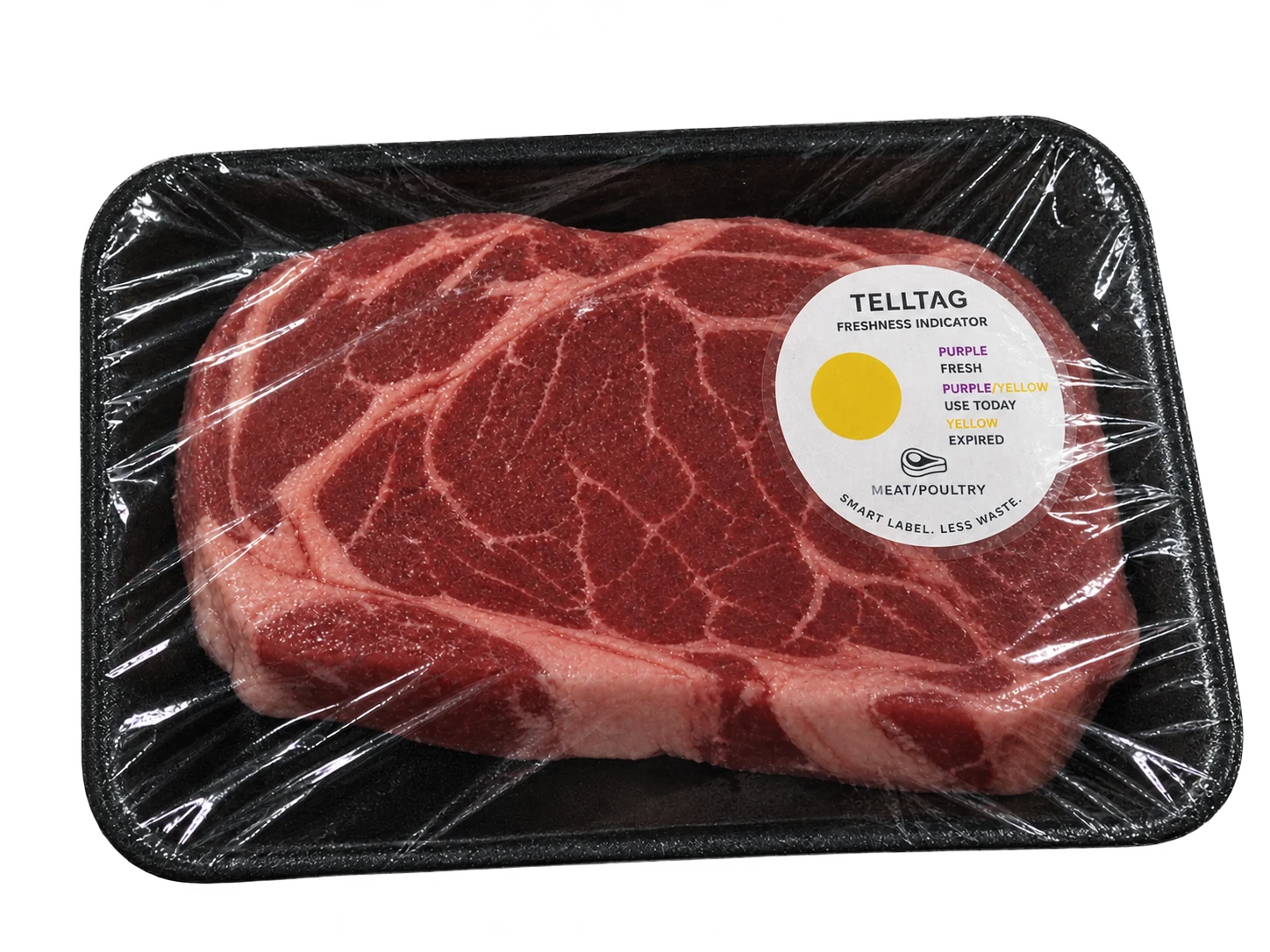
The date onthe packageis a guess.
Telltag is a multilayer indicator label that detects the volatile basic compounds released by meat during microbial spoilage and translates their concentration into a colorimetric signal on the package.
A printed date is an estimate fixed before the package leaves the plant. Telltag is a continuous measurement taken at the food itself, with no contact between indicator chemistry and product. The indicator remains purple while the meat is fresh and shifts to yellow as spoilage compounds accumulate.
The objective: less edible food discarded, and a lower risk of consuming food that has spoiled.
See the chemistryWhat a printed datethrows away.
Each year, about 151,800 tonnes of beef in the EU is thrown away because a printed date said so, not because it had gone bad. Eating that beef instead would save, every year:
0
cattle whose beef is thrown away
That is 1 in every 43 animals slaughtered for beef in the EU.
0.0
million tonnes of greenhouse gas
More than Estonia emits in a whole year (14 million tonnes).
0.0
million cars' worth of emissions for a year
More than every car on the road in Denmark (2.7 million).
0.0
million hectares of farmland
About the size of Slovakia (4.8 million hectares).
0
billion litres of freshwater
Enough to fill 88,000 Olympic swimming pools.
0
million 200 g portions of beef
1.7 portions for every one of the 449 million EU residents.
These are ceilings, not results: 6.6 million tonnes of beef in the EU × 23 % lost or wasted × up to 10 % linked to date marking, then multiplied by published per-kilogram factors. Telltag has not prevented any of it yet.
Sources: Eurostat · FAO · Karwowska · FAO · European Commission · FAOSTAT via Our World in Data · Poore & Nemecek · US EPA · UNFCCC national inventories 2024 · ACEA · UK DfT · World Bank · Eurostat · UN World Population Prospects 2024
MEAT / POULTRYFreshness indicator / 001
Purple
Fresh
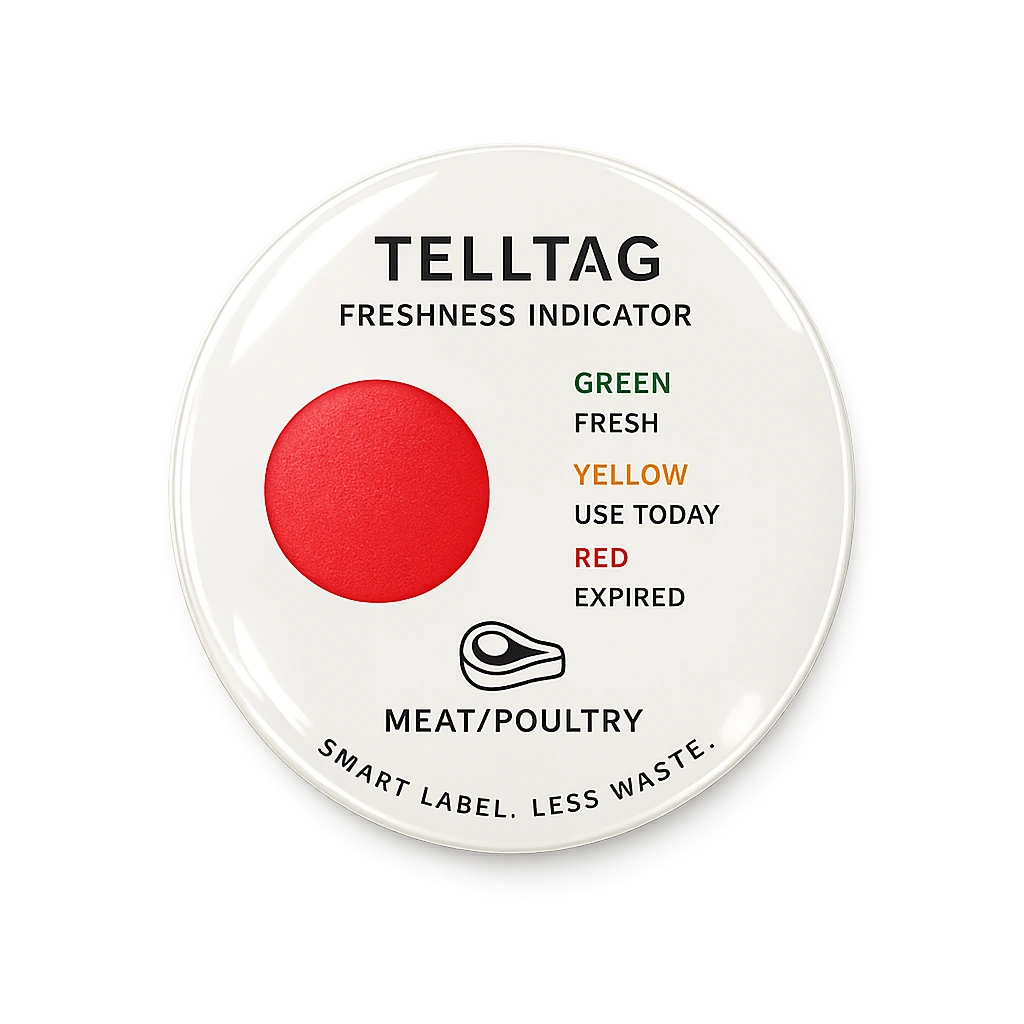
How the indicator works
A measurement,not an estimate.
Four functional layers, each with a defined role, plus a release liner removed at application.
03
Chemical indicator layer
Contains a pH-sensitive dye, for example bromocresol purple, that changes colour when it reacts with volatile spoilage compounds. It is what you see through the window.
Tap any element for detail
Best before datesare built to be safe.Not to be accurate.
A printed date must cover the worst case, so it is set conservatively and never updates. Telltag replaces it with the measured state of the food: purple, consume; purple-yellow, consume today; yellow, discard.
Waste less.
Stay safe.
Making expirationdates obsolete.
Telltag is a pre-commercial materials science company developing gas-reactive freshness indicators for meat packaging.
The indicator combines pH-sensitive dyes with nano-enabled sensing chemistry to quantify spoilage metabolites directly, replacing an elapsed-time estimate with a measurement of the food's actual condition. The objective is to substitute arbitrary printed dates with real-time biological data, reducing household food waste and improving food safety in the same step.
The product is not yet on the market. Telltag is raising its first funding round to build and test the first generation of prototypes.
Investor and pilot enquiries